A new publication on the evolution of mixing regimes in French lakes
 Results from the SECCELA project were published at the beginning of the year in the journal Climatic Change. The SECCELA project, led by the ECLA R&D unit, aimed to better characterize the response of water bodies to climate change.
The study characterized the mixing regimes of 170 water bodies in France over a 60-year period and assessed the existence of potential shifts in dominant mixing regimes over time.
Study objectives
Climate warming has numerous impacts on the functioning of lake ecosystems, and many processes are linked to water temperature. Temperature differences between the surface layer of a lake (epilimnion) and the bottom layer (hypolimnion) in particular control water mixing. Under the influence of climate change, surface layers are warming, which may limit mixing phases depending on the water body. This study calculates and analyzes the mixing regimes of 170 lakes in mainland France. It is the first study conducted at this scale and proposes both a categorization of mixing regimes and a characterization of the impact of climate change (warming) on these mixing processes.
A better understanding of mixing regimes makes it possible to better constrain the functioning of water bodies and their potential response to climate warming.
Method
The analysis is based on the LakeTSim dataset (Sharaf et al., 2023), developed and published by the same team in 2023. LakeTSim provides simulated time series of temperatures for the epilimnion (surface layer) and hypolimnion (deep layer) of lakes. The use of modeling is a major asset when field data are absent or infrequent, as is often the case for monitoring conducted under the Water Framework Directive.
In this study, only simulations from the calibrated mode of the model were used (see the “Further reading” section at the bottom of this page). This choice is explained by higher uncertainties for lakes without in situ data, particularly for the hypolimnion, thus highlighting the importance of field observations.
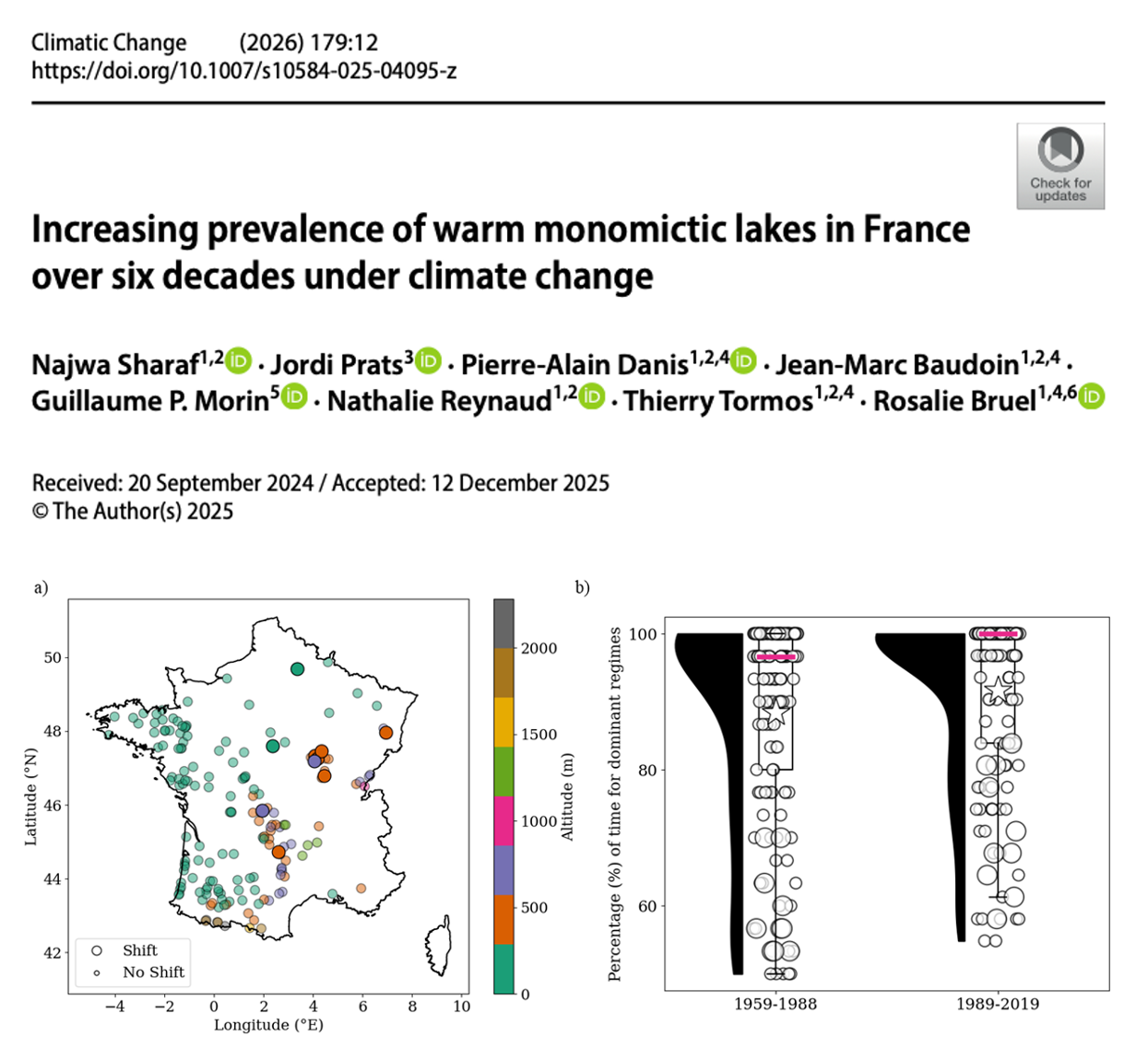
Annual mixing regimes were therefore calculated for 170 lakes over the period 1959–2019. In a second step, the study period was divided into two 30-year sub-periods (1959–1988 and 1989–2019). Dominant mixing regimes were determined for each period. Lakes with “constant” mixing regimes (the same regime calculated over the entire period) were distinguished from lakes with “marginal” mixing regimes (at least two mixing regimes observed over the given period). Finally, dominant mixing regimes were compared between the two periods in order to identify potential changes.
Main results
- While a single mixing regime is commonly attributed to a lake (“constant” mixing regimes), the results confirm that some lakes can exhibit mixing regimes that vary from one year to the next (“marginal” mixing regimes), as previously highlighted by studies within the international scientific community.
- Nevertheless, overall, the proportion of lakes presenting “marginal” mixing regimes decreased between the two periods, and the proportion of the dominant regime increased.
- Over the period 1959–1988, 55% of lakes were warm monomictic, 30% polymictic, and 15% dimictic, with 57% of lakes classified as having “marginal” mixing regimes (compared to 44% during the second period).
- Only 6% of lakes experienced a shift in their dominant mixing regime between the two periods studied. These lakes (6%), all located at low altitude (< 800 m) in central and northeastern France, shifted from a dimictic to a warm monomictic regime, representing 77% of low-altitude dimictic lakes.
- The lakes studied show a generalized warming of the epilimnion, occurring more rapidly than the warming of air temperature.
- Lakes that exhibited a shift in dominant mixing regime experienced a more pronounced warming of the epilimnion (0.25 °C per decade) than lakes that did not change regime (0.2 °C per decade), as well as an increase in thermal stability and density gradient.
- High-altitude lakes remained dimictic, with more moderate epilimnion warming and a specific decrease in winter solar radiation, without any significant change in the density gradient.
These results provide new insights into the dynamics of mixing regimes in French lakes over six decades, with important implications for understanding the ecological impacts of climate change and for guiding management strategies. In the future, a reduction in mixing is expected in dimictic lakes, particularly those at low altitude.
More information
| Link to the study (Open Access) | Sharaf et al., 2026 https://link.springer.com/article/10.1007/s10584-025-04095-z |
| OKPLM model | The semi-empirical OKPLM model (Ottosson-Kettle-Prats Lake Model ; Prats & Danis, 2019) makes it possible to simulate epilimnion and hypolimnion temperatures using a limited number of morphometric parameters (latitude, altitude, maximum depth, surface area, volume) and climatic forcing data (air temperature and solar irradiance). Two calibration modes are available:
This approach makes it possible to generate temperature time series for lakes that are sparsely instrumented or not instrumented at all ((Sharaf et al., 2023). |
| Dataset LakeTSIM (Open Access) | Sharaf et al., 2023 https://essd.copernicus.org/articles/15/5631/2023/ |
| Visualisation of the simulations | Simulation data can be accessed lake per lake at this link: https://geo.ecla.inrae.fr/maps/acceuil-map#project |
Last update on 02/02/2026.