Thermal response of mountain compartments to heatwaves: a new article published by a ZAA consortium
2022 was the hottest year ever recorded in mainland France since measurements began in 1900, and the 10 hottest years on metropolitan territory have all occurred since 2010 (Météo France, 20/01/2026).
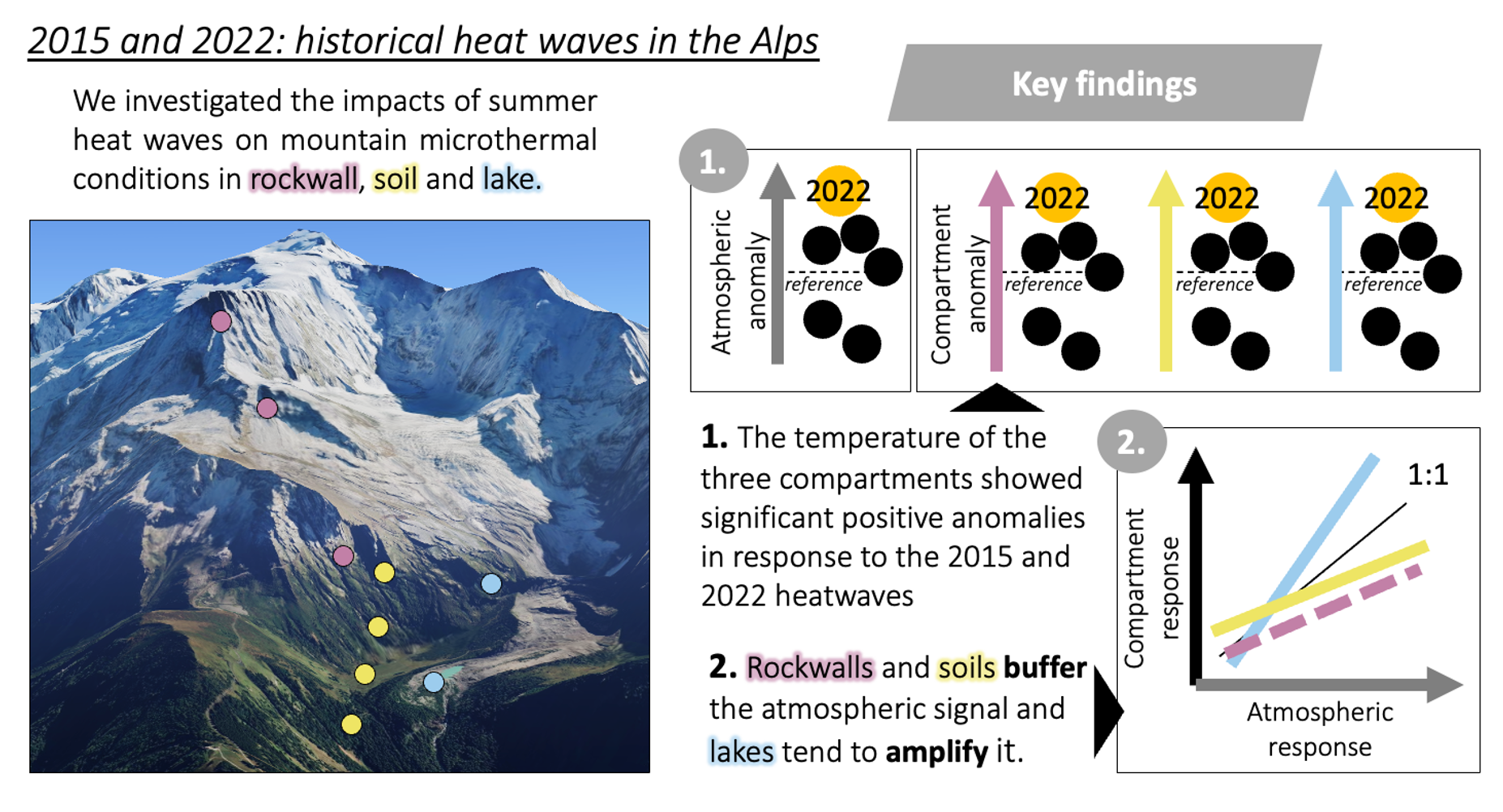
Researchers and site managers came together through the Alpine Long-Term Ecological Research Zone (Zone Atelier Alpes, ZAA) to pool the data available to them. In total, high-frequency data (one measurement per hour) from 95 sites were assembled and harmonized into a common format. Experts then worked together to identify indicators shared across compartments that would make it possible to quantify the response of the different compartments.
Among the three compartments studied, lakes showed the strongest response. Although the summer of 2022 was particularly hot in the atmosphere (+1.6 °C for July–August temperatures in 2022 compared with the reference period used), lakes exhibited an average anomaly of +4.1 °C. Significant anomalies were also observed for soils (+2.1 °C in 2022) and rock walls (+1.6 °C in 2022). The study showed that lakes amplify the atmospheric signal, whereas soils and rock walls have a buffering effect. However, these conclusions should be interpreted with caution, as the study’s results suggest that this heat-buffering capacity could be weakened by the repetition of heatwaves. The study also evaluated the effect of the 2015 heatwave, with comparable results.
The conclusions highlight the importance of observatories for characterizing the real response of environmental compartments to climate change in all its facets (warming, heatwaves).
To read the full study: https://link.springer.com/article/10.1007/s10113-025-02517-3
Click on the logos to read the news on the partners’ websites:


Bruel, R., Arthaud, F., Magnin, F., Napoleoni, R., Van Reeth, C., Augé, V., Sagot, C., Fructus, M., Birck, C., & Choler, P. (2026). Different temperature responses of mountain rockwalls, soils, and lakes to summer heat waves. Regional Environmental Change, 26(1), 34. https://doi.org/10.1007/s10113-025-02517-3
Last update on 06/02/2026.